Rome's Arc de Triomphe: everything you need to know
The Arch of Triumph in Rome was built to commemorate a victory by Constantine I and is very well preserved, so you can visit it on your trip to Rome.

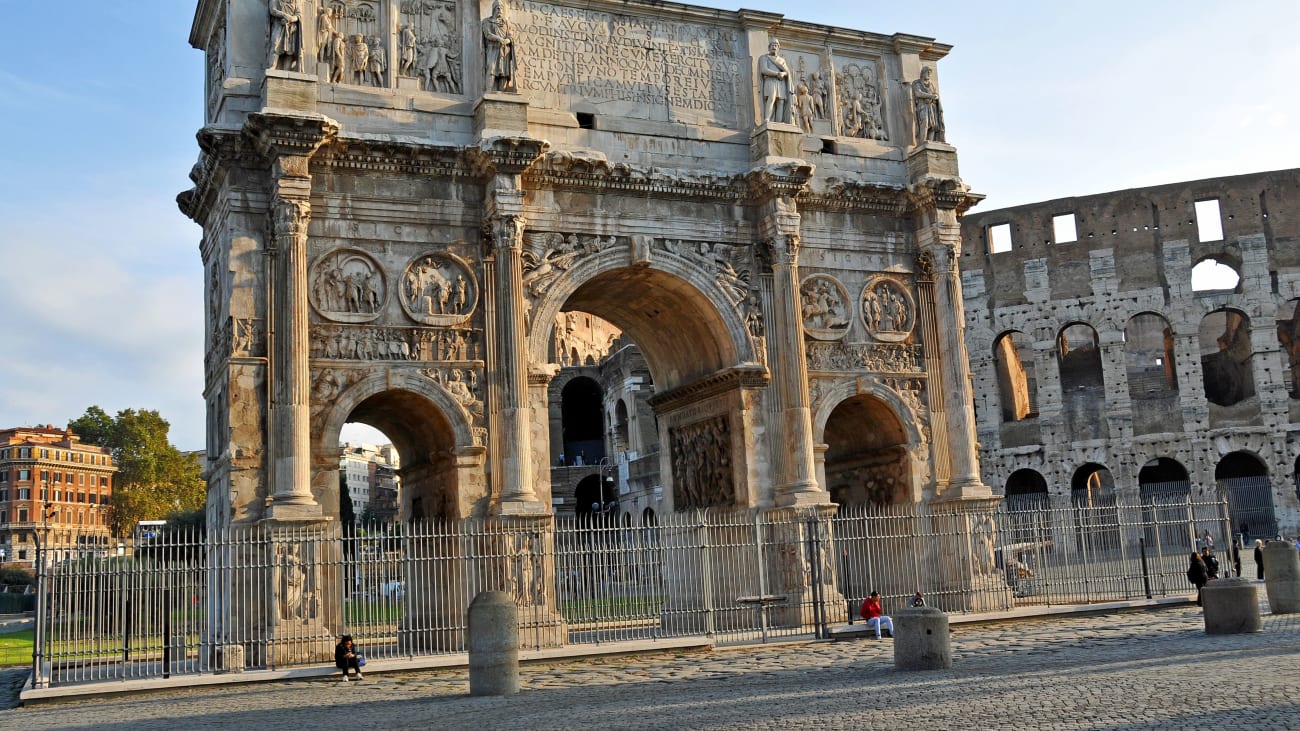
View of the Arch of Triumph in Rome | ©Dennis Jarvis
Triumphal arches were built in many European countries to commemorate military victories. There are several in Italy’s capital, such as the Arch of Septimius Severus, the Arch of Titus, and the Arch of Triumph in Rome. The latter, located next to the Roman Colosseum, is the one I’d like to focus on.
Also known as the “Arch of Constantine,” it is one of the more recent Roman monuments (built in 315 AD), and both its location and its structure make it the most visited arch in Rome.
Guided Tours of Rome’s Arch of Triumph

In 312, Constantine defeated Maxentius at the Battle of the Milvian Bridge, a key victory on his path to power. Three years later, in 315, Rome dedicated the Arch of Constantine to commemorate that triumph. Located next to the Colosseum, it’s one of those monuments worth taking the time to examine closely during a guided tour of the Colosseum and the Roman Forum, because many of its details reveal much more than meets the eye:
- Many of its reliefs and sculptures come from earlier monuments, especially from the eras of Trajan, Hadrian, and Marcus Aurelius.
- Its decoration served a clear political purpose: the scenes depicted on the arch helped reinforce Constantine’s image as the restorer of the Empire.
- In the Middle Ages, the monument became part of the Frangipane family’s fortress, though it always remained in its original location.
- Since the Renaissance, it has undergone several restorations. One of the most significant took place in 1733, when some elements that had been lost were reconstructed.
Guided tours will allow you to spot details when you stand in front of it that independent tourists will miss.
How much do tickets to Rome’s Arch of Triumph cost?

The Roman Triumphal Arch is located within the Colosseum Archaeological Park, but since it’s on a public street, you don’t need to purchase tickets to see it.
It’s worth noting that, unlike other arches found in Italy and other European countries, it’s not possible to walk under the Arch of Constantine, as it’s surrounded by protective barriers. Even so, this doesn’t prevent you from getting close enough to see the details of its design.
How to get to the Arch of Constantine

The Arch of Constantine is next to the Colosseum, and there are several modes of transportation that stop near it, specifically at Piazza del Colosseo. If you want to visit this monument—no matter where you are in the Italian capital—here’s how to get there:
- Bus: Take lines 51, 75, 81, 85, 87, or 118—all of which will take you to Piazza del Colosseo.
- Metro: You’ll need to take Line B, which goes to the Colosseo stop.
If you decide to take the metro, I recommend reading my guide to the Rome Metro.
Why visit Rome’s Arch of Triumph?

The Arch of Constantine is one of the most visited monuments in Rome. And the main reason I encourage you to see it is its architecture—it stands an impressive 21 meters tall and is 25 meters wide.
The central arch is the largest and features reliefs of emperors and warriors throughout the structure. Many centuries ago, people could walk underneath it, but that’s no longer possible. Obviously, the Arch of Constantine doesn’t look the same as it did in the 3rd century, but it’s still well worth seeing.
Another reason why it’s a great option to visit is that it’s located at a strategic point in the city. What do I mean by that? After visiting it, you can go see the Colosseum, the Roman Forum, and the Palatine Hill or the Arch of Titus.
Is it a good idea to visit Rome’s Arch of Triumph with children?
Yes, it’s a monument they’re sure to enjoy seeing and that will leave them impressed. Plus, they can walk safely in the area around the arch.
If you’d like to do something during your vacation in the capital that’s perfect for your children’s ages, I recommend reading another one of my articles where I list 10 things to do in Rome with kids.
What to Look For at Rome’s Arch of Triumph
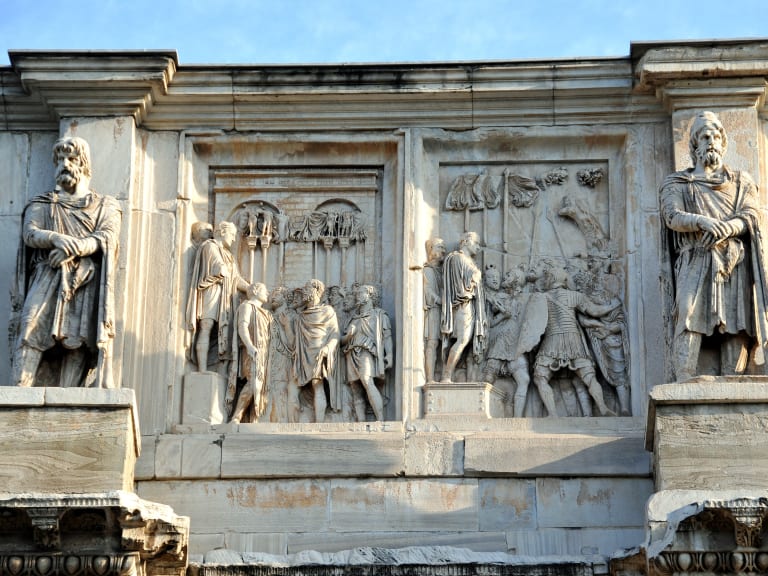
The Arch of Constantine is constructed from various materials: marble for the lower sections and brick with marble blocks for the upper sections. These materials were reused because, at the time of its construction, Rome was in a state of decline and the end of the empire was approaching.
Although it was built in the 3rd century, the Arch of Constantine is very well preserved, thanks to the restorations that have been carried out.
Even today, seeing the Arch is a wonderful experience, so instead of just rushing through it, I encourage you to take a few minutes to observe the details.
Read the inscription on the Arch
On the side of Rome’s Arch of Constantine facing the Colosseum, there is an inscription, and what it says reveals a great deal about the empire and Emperor Constantine. For example, the phrase “inspired by the divine” is used, which serves as a reminder that Constantine, unlike other emperors, supported Christianity.
On the other hand, when referring to the people he defeated, they were not named but were instead called “the tyrant.” In this way, the message was conveyed to the people that the war that had been waged was just. This inscription also makes it clear that it was the Senate that solemnly dedicated the Arch to Constantine.
Since visitors cannot walk under the monument, I’d like to mention two inscriptions found inside the larger arch:
- The liberator of the city.
- Founder of peace.
Marvel at the precision of the reliefs and observe the statues
The reliefs on the monument’s exterior walls are carved from marble blocks. They are intended to depict the wars and victories of the eras of Hadrian, Marcus Aurelius, Trajan, and Constantine (the latter emperor being the central figure).
Among the most notable reliefs are the following:
- Faces of emperors that have been altered to resemble Constantine.
- Marcus Aurelius giving bread to the poor.
- Roman soldiers in battle.
- Victory processions.
As for the statues, they are located in the upper section and depict Trajan after his victory over the Dacians.
Look at the columns of the Arch
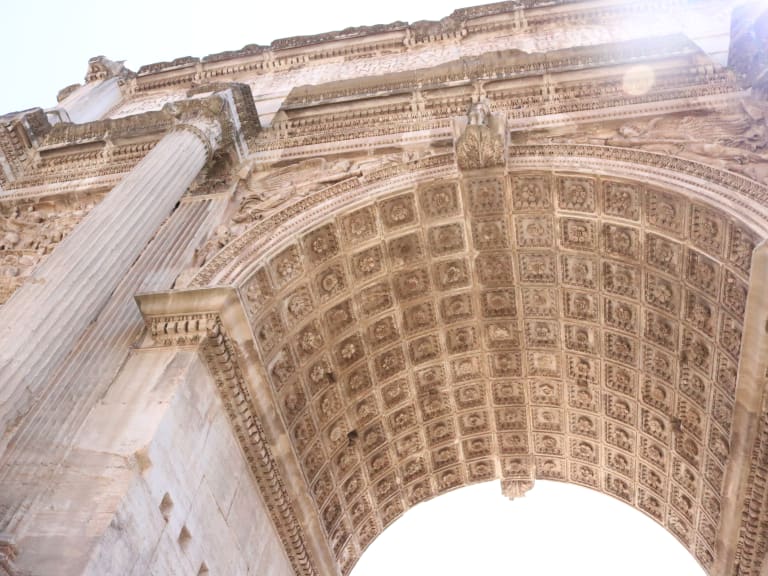
The Arch features four Corinthian columns that, before being installed in this monument, were part of another structure built in the 1st century that was lost over time. All the columns rest on bases featuring sculptures of winged victories, depicting Roman captives, Roman legionaries, and palm fronds.
Not all the elements on this great arch were reused; some were created specifically for this monument dedicated to Constantine. These depict the emperor’s military exploits and can be seen in the following areas of the Arch:
- On the left side of the south facade: the siege of Verona.
- On the right side of the south facade: the battle with Maxentius.
- On the left side of the north facade: a scene in the Roman Forum.
- On the right side of the north facade: a gift-giving ceremony.
Check out the Meta Sudans
Directly in front of Rome’s Arch of Triumph stand the remains of a monumental fountain that was in use until the 5th century. The structure stood an impressive 18 meters tall, had a cylindrical base, and was clad in marble. It is said that gladiators would leave the Colosseum to cool off at the fountain and clean their wounds.
Its diameter was about 16 meters, and its depth was approximately one and a half meters. The last photographs of the Meta Sudans date from the 19th and 20th centuries; by that time, it stood only 9 meters tall and had lost its marble cladding.
What remained of the monumental fountain was dismantled in 1936, and today only its ruins remain. If you’re interested in this topic, I’ll tell you about the top 5 fountains in Rome in another article.
Tips for Visiting the Arch of Constantine

Rome’s Arch of Constantine is located in one of the city’s most visited areas, so during peak seasons, it can attract more than 3,000 visitors. Therefore, if you’re the type of person who likes to admire a monument up close and take in its details, I recommend going in the morning or late at night.
Many tourists—and even people who live in Rome—choose to visit the Arch of Triumph after dark. The truth is, there are plenty of things to do in Rome at night.
During those hours, you can spend as much time as you like exploring the Arch and strolling through the surrounding area to discover other Roman landmarks. I hope you enjoy your trip to the Italian capital to the fullest.