









More about: 10 Best Museums in Lisbon
Lisbon is one of the most authentic cities in Europe, so if you plan to spend a couple of days there, I recommend signing up for a museum tour. It's one of the best things to do in the city, as you'll find buildings housing collections of jewelry, private objects, and carriages. You can also immerse yourself in a historical tour led by heartbreaking stories at the Earthquake Museum.
If you prefer more lively experiences, you might enjoy a dynamic and interactive adventure through the Benfica stadium and museum. On the other hand, if you want to discover the best places to listen to Fado in Lisbon, I suggest you start with the local museum dedicated to this musical genre. There is even a building known as the National Tile Museum, where you can learn about the iconic ceramics that decorate the city. Want more details? Keep reading!
1. Benfica Museum, a Lisbon landmark

The passion for soccer is felt to the extreme in the heart of Portugal, so it's no surprise that they have a building dedicated to this exciting sport. The Benfica Museum is located inside the Benfica Stadium, also known as Estadio da Luz, which is renowned for being one of the most iconic attractions and one of the best things to see and do in Lisbon.
With activities for all ages, this place combines the fun of a guided tour of the stadium with the history of the club. The experience is completely interactive and allows you to walk through the players' exclusive areas, such as the locker rooms, tunnels, and VIP areas.
The museum's facilities house a collection of photographs, trophies, and interesting anecdotes. To visit, you will also find tours with priority access, commentary from a local guide, and approximately two and a half hours of touring.
Details of interest
- Price: admission is free, but you can book a guided tour of the entire stadium from €17.
- Location: Av. Eusébio da Silva Ferreira, at the Benfica Stadium.
- Hours: every day from 10:00 a.m. to 6:00 p.m., but closed on holidays and when there are games or concerts.
- How to get there: You can easily get there by public transport; the nearest metro station is Azul at Colégio Militar. The best tourist buses in Lisbon also have routes that connect to this area.
2. Former Royal House at the Royal Treasury Museum

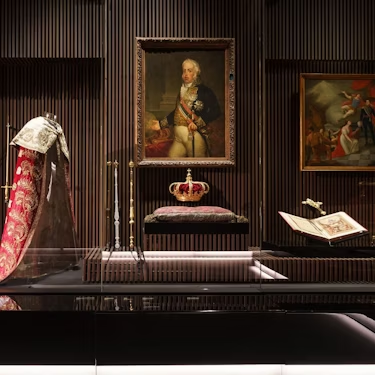
This list would be incomplete without the Royal Treasury Museum, whose name gives you a preview of what you'll see inside. It is one of the most visited museums, as it houses an impeccable collection of jewels that belonged to the Portuguese crown. It is divided into 11 themes, making the exhibits more accessible and enjoyable. Get ready to go up and down its three floors, where interactive experiences await you.
It is a large building that is best explored at your own pace, so we recommend taking a self-guided tour based on your preferences. This way, you will have enough time to visit the Ajuda National Palace, located in the newest wing. In fact, the most interesting thing is that the museum was built in the former Royal House, a palatial structure that has survived years of history.
Centuries ago, the collections were private, but today they are accessible to the general public. Some of the valuable objects you will see include crowns, silverware, items used for royal rituals, medals, diplomas, and the last Germain tableware in the world.
Details of interest
- Price: from €11.
- Location: on Calçada da Ajuda.
- Opening hours: every day from 10:00 a.m. to 5:00 p.m.
- How to get there: the easiest and fastest way is by bus.
3. Earthquake Museum

In contrast to the jewelry collections and sports history, there is Quake, or the Lisbon Earthquake Museum, where it is crucial to maintain a respectful attitude, as you will travel back in time to the exact moment when one of the deadliest earthquakes in Europe occurred. Through an audio guide, you can learn about the history of this event, which was triggered by a reverse tectonic fault that took the inhabitants completely by surprise.
You will have approximately one hour and forty minutes to visit around 10 rooms that recreate the streets of the capital and transport you back to November 1, 1755, when the earthquake occurred. During the visit, you can climb into the simulator that allows you to experience firsthand, and safely, the earthquake with an estimated magnitude of 8.5-9.0 on the Richter scale.
In addition, you will witness the daily life of the locals at the time and you can attend All Saints' Day mass in a church simulator. In fact, the story does not end with the earthquake. It is estimated that between 10,000 and 100,000 people died, as the movement triggered a tsunami and forest fires that completely destroyed the capital.
To better understand every detail, you'll find 4D exhibits, and admission usually includes an RFID bracelet that allows you to interact with the multimedia screens. Keep an eye out to explore how Pombaline architecture, notable for its classic tiles, was born in the wake of this event.
Details of interest
- Price: from €21.
- Location: at R. Cais de Alfândega Velha 39.
- Hours: every day from 10:00 a.m. to 6:00 p.m.
- How to get there: you can take the train, metro, or bus.
4. Calouste Gulbenkian Museum

The Calouste Gulbenkian Museum is another must-see, as it houses one of the best private collections in the world. The reason it came to public attention is that its owner, Armenian engineer Calouste Gulbenkian, stipulated in his will that it would be a gift to the country where he spent his final years. As a result, you will find antique art, with pieces ranging from Ancient Egypt to the 20th century.
Specifically, it covers various eras and cultures, including Egyptian and Greco-Roman art, pieces from Mesopotamia, objects from the European Middle Ages, René Lalique's art nouveau jewelry collection, and objects from Persia, Turkey, India, and Armenia. You will also find an extensive collection of Portuguese art, predominantly from the 20th century.
This place also houses a beautiful bookshop, gardens where you can enjoy a stroll, and an open-air auditorium. The best way to discover each space is with a ticket that includes a downloadable audio guide and access to all areas. In addition, to delve deeper into the history of each work, you will have touchscreen information stations at your disposal.
Details of interest
- Price: from €11.
- Location: at Av. de Berna 45A, specifically in the Calouste Gulbenkian Foundation Park.
- Hours: every day (except Tuesdays) from 10:00 a.m. to 6:00 p.m.
- How to get there: the best option is to use the Lisbon Metro or Carris bus lines 716, 726, 746, and 767.
5. National Archaeology Museum

If you want to visit the largest museum of archaeological finds in Portugal, then you have to head to the National Archaeology Museum in Lisbon. It was founded in 1893 and is located in the Jerónimos Monastery, making it one of the best things to do in Belém.
Here you can enjoy a tour of the most important collections from the Iberian Peninsula, as well as a collection of objects from the Arabian Peninsula. There are temporary and permanent exhibitions, among the most notable of which is the funerary art corridor with mummies, sarcophagi, talismans, and more. You will also find Roman ceramics, Islamic bronze, and the treasure room, which houses a collection of Portuguese gold and silverwork from the 6th century BC.
On the other hand, if you are looking for things to do in the center of Lisbon, another similar option is the Carmo Archaeological Museum, located in a former medieval convent with an impressive collection dating from the 19th to the 21st century. You can see medieval burial mounds, sarcophagi, pre-Columbian mummies, Roman epigraphy, tile panels depicting the Passion of Christ, and more. The best thing is that it is a less touristy alternative.
Details of interest
- Price: the Archaeology Museum offers tickets from €5, but you can also take a combined tour with tickets to the Jerónimos Monastery, or take advantage of the Lisboa Card, which gives you access to dozens of museums and monuments. On the other hand, if you want to visit the Carmo Archaeological Museum, tickets start at €5.
- Location: The Lisbon Museum of Archaeology is located in the Jerónimos Monastery in Belém, specifically in Praça do Império. The Carmo Archaeological Museum is located in a former convent in the parish of Santa María Mayor, at Largo do Carmo 27.
- Opening hours: The Archaeology Museum is open Tuesday to Sunday from 10:00 a.m. to 6:00 p.m., while the Carmo Archaeological Museum is open Monday to Saturday from 10:00 a.m. to 6:00 p.m.
- How to get there: The best option is by tram or bus, so in these cases, I recommend taking advantage of a savings pack that includes the Lisbon tourist bus, tram, and boat.
6. National Tile Museum

It is impossible to ignore the beauty of Lisbon's Pombaline architecture, which is notable for its tiles, a form of visual art characteristic of Portugal since the 15th century and predominant in Lisbon since the 1755 earthquake. The best place to learn about its history in an interactive experience is the National Tile Museum. Here you can immerse yourself in a journey through the history of Portuguese ceramics to the present day.
This special place is located in the ruins of the former convent of Queen Leonor and houses an impressive 23-meter tile panel. Here you can learn about the manufacturing process and walk through a hallway lined with international tiles from Spain, Holland, and England. You will also find special activities, such as ceramics workshops where you can make your own piece to take home.
Details of interest
- Price: from €5, although it is free with the Lisboa Card. You can also take a combined tour of the National Pantheon.
- Location: in the Convento da Madre de Deus, located at R. Me. Deus 4.
- Hours: Tuesday to Sunday from 10:00 a.m. to 6:00 p.m.
- How to get there: the best option is by bus.
7. Fado Museum

A musical genre was born in the neighborhoods of Lisbon that is now very important in local culture, so a visit to the Fado Museum to learn about its history is a must. Fado is a genre characterized by melancholic songs that tell moving stories, accompanied by Portuguese guitar.
Here you can discover its secrets through films, photographs, instruments, and other valuable objects. It is the perfect place to introduce yourself to the Portuguese spirit and discover the best places to listen to Fado in Lisbon. It also offers Fado workshops and Portuguese guitar courses. If you are lucky, your visit may coincide with a special concert in the auditorium.
Useful information
- Price: from €5.
- Location: it is one of the top activities to do in the Alfama neighborhood, specifically located at Largo do Chafariz de Dentro 1.
- Opening hours: Tuesday to Sunday from 10:00 a.m. to 6:00 p.m.
- How to get there: Take bus line 734 or a taxi.
8. National Carriage Museum

One of the most interesting attractions is the National Carriage Museum, which has two buildings housing dozens of cars, carriages, and floats dating from the 17th to the 19th centuries. The collection includes the royal wedding carriage of João V and Maria Ana of Austria, as well as other antiques used to transport diplomats, European royalty, clergy, and others.
You can also see fatetons, a very popular carriage from 1900 to 1930, and other types of carriages such as sedans and coupés. It is one of the most visited places, especially on the first Sunday of each month, around 11:00 a.m., when you are likely to see the changing of the Republican guard. This event will make you feel like you are in a period film, as it usually includes music from the orchestra and parades.
Details of interest
- Price: from €8.
- Location: it is one of the best things to do in Belem, as it is located in Afonso de Albuquerque Square.
- Hours: Tuesday to Sunday from 10:00 a.m. to 6:00 p.m.
- How to get there: by bus.
9. Interpretive Center for the History of Cod

Porto or Lisbon? Definitely a difficult decision that will depend on what you want to experience, but when it comes to gastronomy, it's worth visiting the capital where the famous Pastéis de Belém originated. Here you can also immerse yourself in the Cod History Interpretation Center, which highlights the importance of this fish in Portugal's culinary culture.
During the interactive experience, you can climb aboard a typical dori boat, touch cod, prepare local recipes, and walk through the Cod Encyclopedia corridor to explore educational exhibits. There is also a shop where you can sample and purchase cod-based products such as oils, preserves, sea salt, and more.
The experience can be twofold, as it is located in the same building as the Lisbon Story Center, another museum where you can discover the history of Lisbon through scenery, interactive maps, recordings with testimonials, and more.
Details of interest
- Price: from €4.
- Location: in the Lisbon Story Centre, in the heart of Praça do Comércio
- Hours: every day from 10:00 a.m. to 6:00 p.m.
- How to get there: take bus line 760.
10. Money Museum

The Money Museum is a must-see during your stay in Lisbon, as it is a fun and completely free museum. The experience is very comprehensive, as you can take a journey through 2,600 years of local history, focusing mainly on the country's economic growth.
The most interesting thing is that you can create a coin with your face on it, learn how to print banknotes, or look at banknotes under a microscope to see details that are not normally visible. In the famous Vault of Truth, you can lift an authentic gold bar weighing around 12.6 kilograms. Additionally, don't miss the Hermes show, focused on the Greek god of commerce and transactions.
Details of interest
- Price: free.
- Location: Largo de São Julião.
- Hours: Wednesday to Sunday from 10:00 a.m. to 6:00 p.m.
- How to get there: by subway or bus.