

More about: Things You Can´t Miss at La Pedrera Barcelona
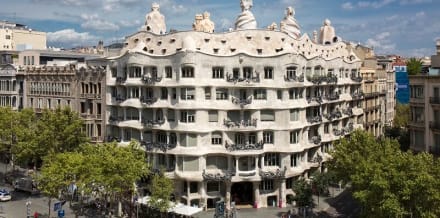
Regarded by experts as Antoni Gaudí’s most iconic work of civil architecture, a tour of the interior of this significant building is essential for understanding the evolution of the renowned Barcelona architect, as well as being one of the best things to do in Barcelona.
Gaudí built La Casa Milà (the building’s real name) at the age of 57 between 1906 and 1912; it was the last project he managed to complete before his death. Works such as the Sagrada Família remained unfinished at the time of his death.
So, if you’ve already got your tickets to La Pedrera, you’re probably wondering: What’s so wonderful about this building? What should I look out for when I visit? Below, I’ll give you all the details of what is, quite possibly, my favourite building in the whole city. I hope you enjoy it!
1. The Entrance Halls

Casa Milà is situated on a corner plot, so it has two main entrances: one on Passeig de la Gràcia and the other directly on the characteristic chamfer formed by the corners of Barcelona’s streets. The lobbies are spacious and filled with light thanks to the windows, a main entrance door made of iron and glass, but above all to the light streaming in from the inner courtyards.
The two lobbies of La Pedrera serve as a connecting point for all the rooms in the complex. The majestic staircases lead directly to the main floor, originally designed as the home of the owners, the Milá family. Access to the other flats and the roof terrace is via the lifts. Gaudí conceived the lift as the main means of vertical communication, installing additional staircases primarily for service use.
2. The crown of the building: the rooftop terrace

The roof terrace of Casa Milà is unlike anything you have ever seen. Here, Gaudí conceived an open space straight out of a fantasy novel. The Spanish poet Pere Gimferrer described this place as “the garden of warriors” due to the 28 chimneys, whose curved shapes bear no resemblance to conventional chimneys but rather resemble imposing masked warriors.
On the rooftop, the undulating pathways give way to steps and uneven surfaces, so during your walk I recommend ** keeping a close eye on your feet**, although this proves difficult as wherever you look you’ll encounter sculptural and architectural details that will captivate your full attention.
In addition to the winding paths, thousands of pieces of broken marble and tiles from Valencia are used to cover several of the chimney sculptures because at night the rooftop is spectacularly illuminated when the ceiling lights come on.
As if all this were not enough, the fabulous terrace offers some of the best views of Barcelona.
3. The Whale’s Attic and the Gaudí Exhibition

Many might wonder whether or not it is worth visiting a building’s attic, but when it comes to a Gaudí building, the answer is always yes. Known as the Whale’s Attic, in Gaudí’s original plans this space was intended to house the building’s service and laundry rooms. However, a service area is not synonymous with a neglected or second-rate space—quite the opposite.
The attic space now serves as a museum, so as well as admiring the structure, you can enjoy the Espai Gaudí collection, dedicatedentirely to the architect’s work. Here you’ll find dozens of models and plans of his most famous works, as well as spectacular scale plaster models designed to study the façade and structure of La Casa Milà.
4. The system of courtyards and its conceptual significance

The system of interior courtyards created by Gaudí served as a rather ingenious architectural solution that helped resolve the problem of ventilation and lighting in the separate blocks of the building. Two interior courtyards, one smaller and the other larger in scale, rise from ground floor level directly up to the roof. Entering these spaces and looking up towards the sky is a delight for the senses; let’s explore the qualities of each.
The Flower Courtyard
The main and decidedly distinctive feature of the Patio de las Flores is, without a doubt, its use of colour. This space is accessed via the entrance hall facing Passeig de Gràcia.
If you come from outside, you will quickly notice that a play of shapes, colours and light offers a spectacle that clearly contrasts with the chromatic sobriety that characterises the façade of Casa Milà. The Patio de las Flores measures 90 metres across, making it the smaller of the two.
The Butterfly Courtyard
For its part, the Patio de las Mariposas speaks to us of nature and life in motion, this being its most striking feature. The structure itself is formed by numerous sculptural forms evoking creatures of nature: a huge butterfly perched on the entrance threshold, or a large wing of some impossibly large insect enveloping the staircase leading up to the main floor. The Butterfly Courtyard is the larger and more imposing of the two, covering 150 m², and is situated behind the entrance hall that connects to Calle Provenca.
5. The basement: an unprecedented innovation!

Following a similar pattern of organic forms, Gaudí conceived this space as a garage, where the carriages and cars that the project’s owner was already fond of could be stored. Access to the basement is via the two main entrance halls through spiral ramps, and this space is currently used as an auditorium.
Setting aside the curved forms, in modern times the basement of La Pedrera might seem to us a common spatial solution in a residential building. However, it is of vital importance to understand the historical context in which this project was built. In 1912, there was no similar solution anywhere in the world; the need to dedicate a space for parking a vehicle was simply not conceived; over the years, this has only served to highlight just how far ahead of its time the building and Gaudí’s ingenuity were, enabling him to reflect on the needs of modern life and anticipate them.
6. The structural system and the use of materials

During your tour of La Pedrera, always try to pay attention to the structural solutions Gaudí devised for the various construction challenges. Whether using stone, brick or iron pillars, he spared no expense in employing the materials that would allow him to provide the best possible solution in every situation.
During your tour, you will notice that the interior layout of the different rooms is characterised by a free-form geometry. The absence of load-bearing walls results in interchangeable spaces that can be adapted to the occupant’s needs. Optimising the façade as a structural system allows loads to be distributed without the need to overload the interior spaces with lintels.
In the attic area, Gaudí employed all his ingenuity to create a framework of 270 parabolic brick arches, the strength of which serves to support the roof located directly above.
7. The neighbours’ flat and the bespoke furniture
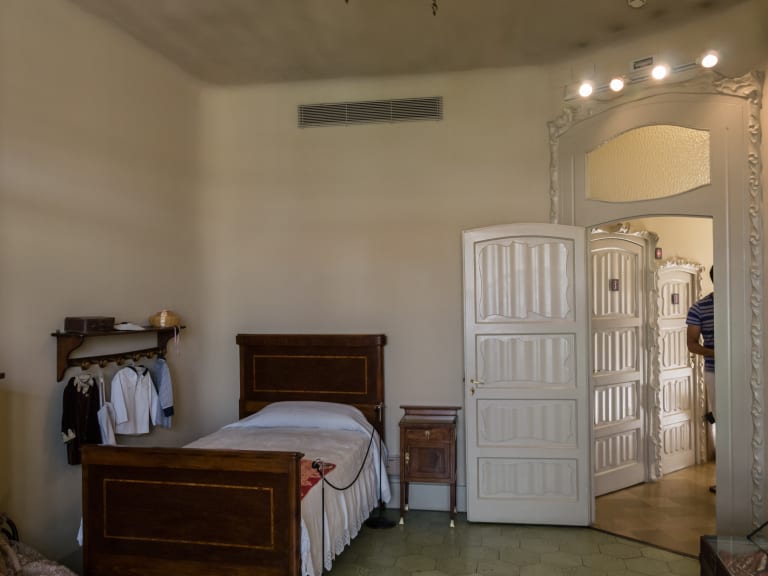
The fourth floor of the building houses what is known as ‘The neighbours’ flat’; the only flat in the entire building whose design and furnishings remain, to this day (more than 100 years later), exactly as Gaudí designed them.
Pere Milà lived in this flat with his family for decades. The interior remains in an impressive state of preservation, so a tour of its rooms is like a journey back in time, offering a glimpse into how Barcelona’s upper class lived at the beginning of the last century. It is both unsettling and wonderful to see how, despite the passage of time, even the children’s toys seem to have been frozen in time.
During your visit, pay special attention to the bespoke furniture designed by Gaudí; true works of art from the Modernist movement.
8. The entrance doors

Access to the entrance hall of Casa Milà is via wrought-iron doors whose appearance serves only to emphasise the unique style of Gaudí’s work. This same style was carried through to all the balconies that feature on the main façade and to other balustrades inside the building.
Their organic design evokes natural forms, from butterfly wings to turtle shells; the combination of materials such as iron and glass serves several purposes: firstly as a protective element from the outside and secondly as a source of natural light that floods the lobby with light.
9. The paintings and murals

Inside Casa Milá, you can find a number of artworks typical of the popular modernist movements of the time. This can be seen in the lobbies, where you can admire the work of the artist Aleix Clapés. His work for Gaudí’s building follows themes inspired by mythology and, although it has undergone several restorations, it remains in superb condition. Pay particular attention to the murals on the staircases connecting the entrance level with the main floor of the building.
It is important to understand that Gaudí’s architecture did not seek to adorn the walls excessively with conventional visual artworks such as paintings; Gaudí preferred to integrate art directly into the form through the combination and use of different materials to express his creative language.
10. The façade is a faithful representation of Gaudí’s style

Whether you are leaving or arriving at the building, you simply must take a moment to admire the most striking, unique and eye-catching feature of the entire building: its imposing façade. The façade, constructed entirely of stone and featuring undulating forms, made it a highly controversial design for its time and drew the disapproval of many of his contemporaries. The nickname ‘La Pedrera’ (The Quarry) stems precisely from the mockery of those who, at the time, considered it an ugly and unpleasant building.
Casa Milà is considered an innovative work primarily due to its all-steel structure and the use of curtain walls, particularly in its self-supporting façade. The use of undulating stone to create unique organic forms is complemented by the addition of wrought iron, which features in the imposing entrance doors (which also incorporate glass), the balcony balustrades and the windows facing directly onto the streets.
This was the last civil engineering project the architect undertook before devoting himself entirely to the design and construction of the Sagrada Familia; consequently, La Pedrera showcases the full maturation of his distinctive style. Gaudí has left us with an artificial building that wonderfully mimics nature.