Things You Can't Miss at St. Mark’s Basilica in Venice
If your next travel destination is beautiful Venice, a visit to St Mark’s Basilica is an absolute must, but what will you find inside St Mark’s? Why is it so famous? Here’s everything you need to know.

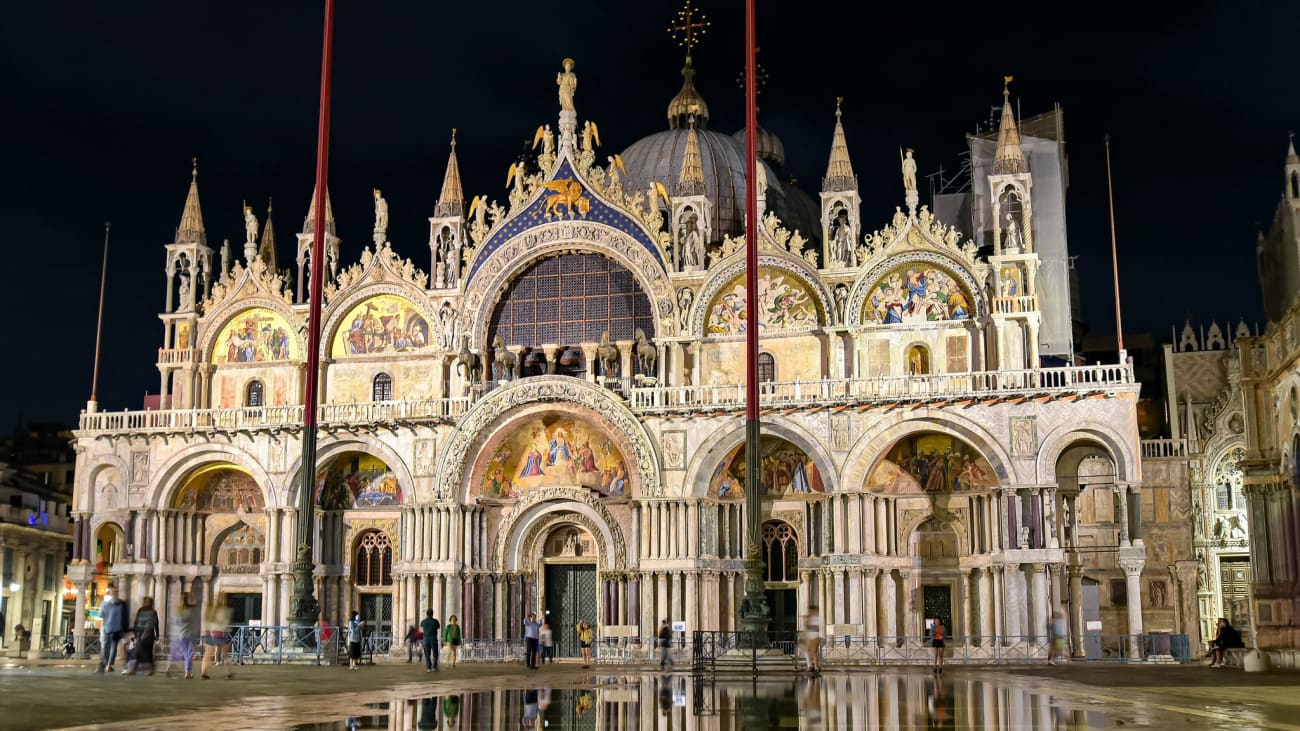
Patriarchal Cathedral and Basilica of St Mark | ©Jorge Franganillo
When planning a travel itinerarywith things to see and do in Venice, three activities always spring to mind: a visit to the Doge’s Palace, a gondola ride along the Grand Canal, and a tour of the interior of St Mark’s Basilica. This impressive basilica is an important part of the city’s religious tradition and history; so I recommend setting aside a couple of hours to discover all its secrets, guided by the following list.
1. Admire the architecture of the façades
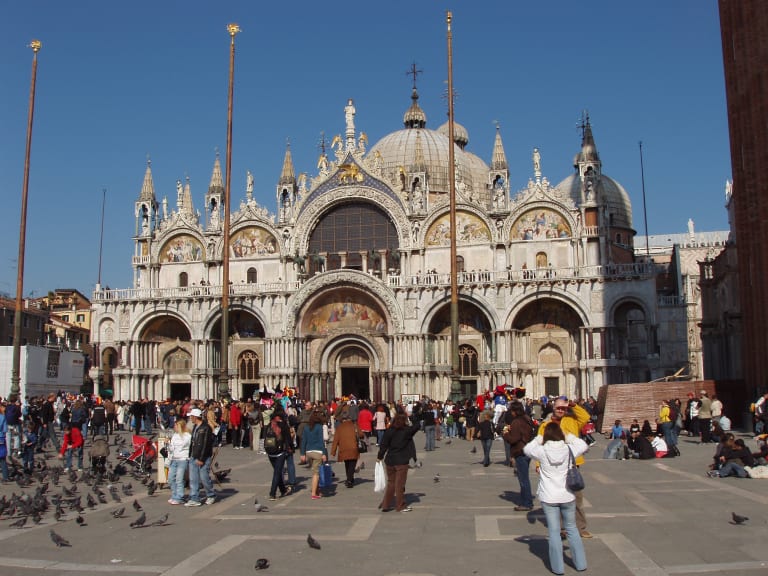
The current appearance of St Mark’s Basilica is the result of renovations and reconstructions carried out in the 15th century. Due to its complex and intricate history, this Venetian monument combines several easily distinguishable architectural styles on its façade, with Byzantine Romanesque and Gothic styles predominating.
The upper section features large pointed arches of Eastern influence, decorated with ceramic tiles characteristic of the Venetian Flourish Gothic style. Statues of numerous saints have been placed atop the arches, and the statue of St Mark himself occupies the place of honour in the centre.
Unlike other major works of its time, the basilica’s façade is wider than it is tall; horizontality predominates in its design as a means of balancing the weight and distributing the loads evenly across the sandy ground on which it was built. Although the most famous façade is the one facing St Mark’s Square, the basilica has three named façades: the west façade, the north façade and the south façade.
2. Marvel at the mosaics

As you begin your tour inside St Mark’s, you will notice the intricate details that make up its decoration; this is particularly evident in the mosaics adorning the lunettes or small entrance vaults.
Pay particular attention to the Basilica’s only entirely original mosaic, located in the portal of Sant’Alipio; it dates from the 13th century and best represents the ancient church of San Marco before the addition of the ornate Gothic elements that stand out most prominently on the main façade. The other mosaics in San Marco are in fact the result of various restorations carried out between the 17th and 19th centuries.
3. Take a look at the floors of St Mark’s
The beautiful floors of St Mark’s are another distinctive feature to look out for on your tour; they consist of geometric patterns and animal designs depicting lions, eagles, griffins, deer, peacocks and other creatures from medieval bestiaries, each imbued with profound symbolic power.
The variety of intricate designs is achieved by combining a wide range of coloured limestones, serpentine and marbles; the materials originate from various locations including Greece, Syria, Africa, Istria, Tuscany, Verona and the Alps. The large floor slabs of St Mark’s are strategically positioned to emphasise the chapel’s longitudinal axis, laid beneath the central dome and the western dome.
4. Impressive with its millions of gilded decorations inside

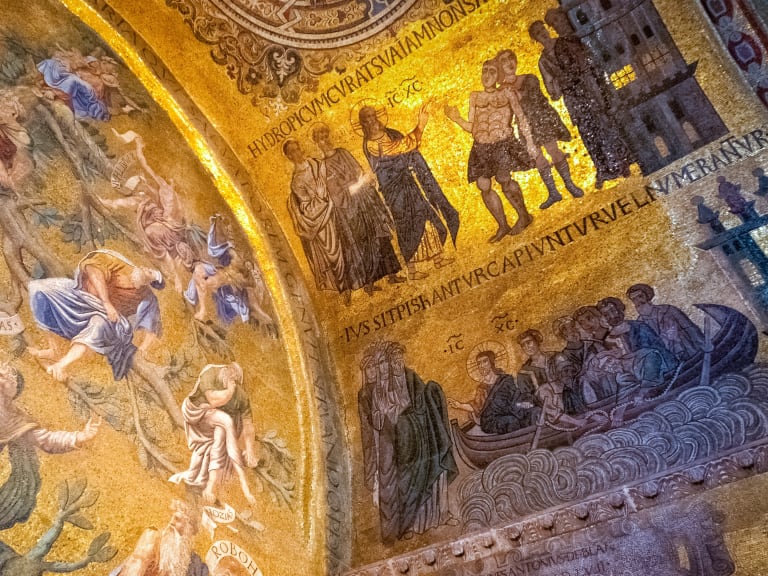
Perhaps the most striking feature of the interior of St Mark’s Basilica are its golden mosaics, which earned it the name the ‘Golden Basilica ’. The golden mosaics cover the interior almost entirely, from the walls to the vaults and up to the domes. Thanks to their arrangement, they shimmer in every direction, creating a fantastic interior composition. Amidst this sea of golden pieces, you will find depictions of biblical episodes, the life of Christ, the Virgin Mary and the Apostle Saint Mark.
5. The High Altar and the impressive Pala d’Oro

The area dedicated to the High Altar in St Mark’s is slightly raised above the rest of the church; it is situated beneath ribbed vaults and four columns covered in sculptures that may have come from the fall of Constantinople. The remains of the Apostle St Mark have rested beneath the altar since the 18th century, although they had to be removed due to the flooding that affects the whole of St Mark’s Square and the surrounding buildings.
Pala d’Oro: situated at the back of the altar; a dazzling panel decorated with metals and precious stones, commissioned in Constantinople in 1102, it is considered one of the greatest treasures within St Mark’s. It depicts religious scenes and figures of saints in miniature and, according to documents from 1769, this masterpiece is composed of: 1,300 pearls, 400 garnets, 300 sapphires, 90 amethysts, 15 rubies, 4 topazes, as well as metals such as gold and silver.
6. Discover the Treasures of St Mark’s

The Treasury of St Mark is the name given to the collection of liturgical objects used in celebrations. The collection includes some 283 pieces of gold, silver and various precious materials of great value and from diverse origins. The objects are mostly liturgical chalices, cups and patens; crafted in the Byzantine style and adorned with all manner of semi-precious stones.
The relics of St Mark are kept in the ancient rooms connecting the church to the Doge’s Palace, and the most significant pieces are usually displayed on St Mark’s altar; so, during your visit to the Basilica, do pay attention to these details. Some pieces are loaned out for display in temporary exhibitions at the world’s most important museums.
According to historical records, some of the 283 items that make up the collection consist of booty looted from Constantinople between 1204 and 1261. The collection is divided into four main groups or sections: ancient and medieval objects, Byzantine art, Islamic art and Western art.
7. The Museum of St Mark

The Museum of St Mark was established in the late 19th century; it is housed on the inner terraces of the basilica and is the venue where relics of Byzantine sacred art are preserved.
The collection includes a series of interesting objects of great historical value, such as ancient personal rugs, liturgical vestments, manuscripts and old mosaic fragments removed during various restoration works throughout the 19th century. It is said that in the past the collection of objects was much larger, but due to various events such as fires and thefts, it has gradually diminished.
8. The Sculpture of the Horses of Constantinople

Following Venice’s participation in the Fourth Crusade, various treasures were taken from Constantinople; the sculpture of the horses, located in the hippodrome of the fallen city, forms part of the spoils taken by the Venetians. Made entirely of copper with additions of mercury, it depicts a quadriga of strong and imposing horses with a spectacular level of detail.
It has not been possible to establish the exact date of the work; whilst some date from the Greek period, others are clearly Roman. Experts in antiquities place it between the 2nd century BC and the 2nd century AD. It is known for being the only sculpture of its kind to have survived from antiquity.
Another interesting fact is that in the 19th century, Emperor Napoleon had the imposing sculpture transported to Paris to create a replica. The quadriga of horses currently on display on the façade of St Mark’s Basilica is also a replica of the original, which is safely preserved and protected inside the church.
9. The sculpture I Tetrarchi or monument to the Tetrarchs
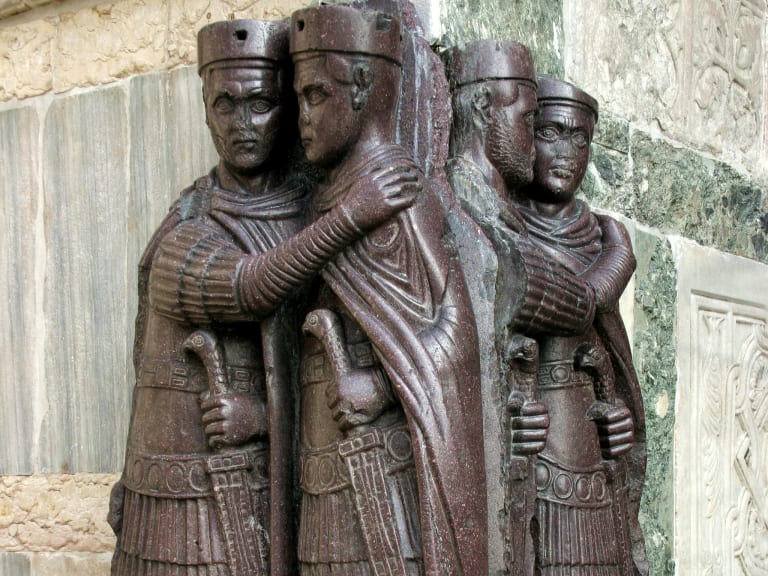
Among the treasures looted by the Venetians during the Crusades in Constantinople, you will find various artefacts and treasures of great value placed throughout the basilica. Near the Porta della Carta, one of the main attractions of the Doge’s Palace, embracing a pillar, stands I Tetrarchi.
Carved from red porphyry, it stands 136 cm tall. Although the sculpture is associated with the Roman Tetrarchs, the truth is that there is no definitive consensus on the matter; evidence suggests that the sculptures may be much older and were perhaps taken from Mesopotamian and Egyptian civilisations.
The Venetians dubbed them the ‘four thieves’ and they were placed to guard the outer wall of the Treasury of St Mark’s; they serve partly as a warning to any ill-intentioned person wishing to desecrate the precious artefacts inside the basilica.
10. Admire the Acritane columns

The Acritane columns is the name given to the pair of columns originating from the ancient, fallen city of Acre. Placed on the south side of St Mark’s Basilica, they hold an extremely interesting historical context. Acre was a very ancient city situated in what is now Israel. These territories were highly coveted by the Venetian lords, but also by the Genoese. Following violent clashes between the two maritime powers, the Venetians emerged victorious.
After their victory, they destroyed the church of San Giovanni d’Acri, removed the two beautifully decorated columns and placed them outside St Mark’s as a warning to their enemies.
Tips for visiting St Mark’s Basilica
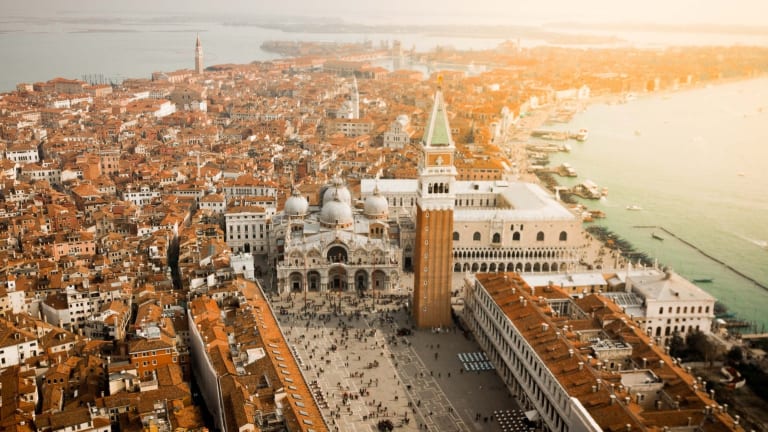
When visiting St Mark’s Basilica, you should bear in mind certain details that will help you save time and effort; add the following important points to your list of tips for exploring Venice.
If you want to avoid queues…
St Mark’s Basilica is one ofVenice’s mainmonuments and, as one of the city’s most popular tourist attractions, there are always queues at the entrance. The only easy way to avoid this inconvenience is to book a guided tour in advance; however, groups available in Spanish may be limited, so it is best and most advisable to book your tours well in advance.
Dress appropriately…
On the day of your visit to St Mark’s, bear in mind that you will be visiting a religious monument; it is important to behave respectfully and adhere to the prescribed dress code. Appropriate attire consists of long trousers or skirts with shoulders covered for both men and women. This applies equally to other Venetian churches.
Bear in mind the visiting conditions…
St Mark’s Basilica has a capacity limit of 200 people, with an average tour duration inside of around 30 minutes. During peak tourist seasons in Venice, the tour duration may be shortened by a few minutes.
You must behave respectfully and quietly, mindful of the sacred nature of the place. Suitcases and travel bags are not permitted inside the basilica; there is a dedicated luggage storage area at the Ateneo San Basso; access to this area is via an alleyway to the left of the basilica.